



Quand le séchage au four ne fonctionne pas

Écrit par Wagner Meters, publié initialement par Floor Trends (numéro de novembre 2014)
Most unfinished wood you’ll find at a lumberyard or flooring supplier has been kiln-dried to bring its moisture content (MC) into a workable range and help prevent problems over the life of the finished product.
Kiln drying is a controlled process that speeds the natural drying of “green” lumber into a wood product that’s much less prone to warping, buckling, splitting, and other moisture-related defects.
However, it’s important to understand that kiln drying doesn’t guarantee a piece of wood flooring will never have moisture-related problems. Kiln drying is only one step in wood’s journey from a living tree to a finished product.
À quoi sert réellement le séchage du bois au four ?
A living tree is a network of interconnected cells and pathways that carry water from the ground up through its trunk and branches to the tips of its leaves. When the tree is freshly cut, that moisture is still in the wood.
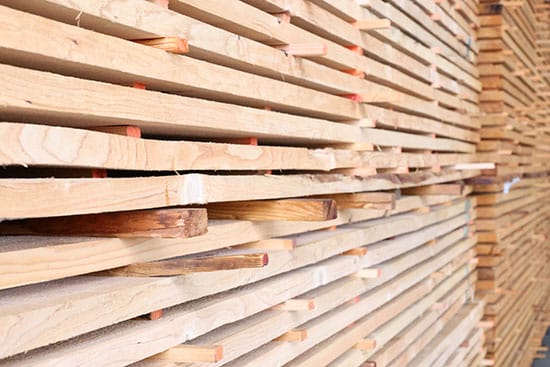 The moisture will eventually evaporate, but this process (called air drying, because the moisture is carried away by the surrounding air) is slow. And if lumber dries too quickly, it can split, warp, or crack, damaging otherwise useful wood.
Séchage au four uses a combination of heat and airflow to lower the MC of green lumber faster than air drying can. The target MC varies by wood espèce and end use, but the goal is for the wood to come out roughly in balance with the conditions where it will be used.
That’s why each charge (or kiln load) is sorted by species and dimensions: to make the process efficient, to get even final MC levels across the charge, and to reach the target MC for the product.
En ligne et au four Systèmes de mesure de l'humidité help determine when the wood has reached its target MC.
Mills and manufacturers invest time, money, and training in their drying processes to deliver uniform wood products at the correct moisture levels for their customers. A well-run kiln removes excess moisture efficiently while minimizing the damage that drying too quickly can cause.
So if the wood leaves the kiln at the required MC, the job is done, right?
Malheureusement non.
Ce que le séchage au four ne fait pas
Wood is hygroscopic, which means it constantly interacts with the moisture around it. Even after the tree is cut and the lumber is dried, the wood’s cells will still absorb or release moisture to reach balance with their environment.
If the surrounding air’s relative humidity is higher, the wood absorbs some moisture. If it’s lower, the wood releases moisture. This continues until the wood reaches a point of balance with the surrounding air, called its Teneur en humidité à l'équilibre (CEM).
Pourquoi est-ce important?
Kiln drying removes most of the wood’s moisture, but the wood doesn’t lose its ability to take moisture back in. Whether it comes from direct contact with water, moisture in an adjacent material, or humidity in the air, wood will absorb moisture it’s exposed to. Kiln drying doesn’t lock in a wood product’s MC; it just brings the moisture down to a workable range.
Le MC de Wood sera toujours une variable et non une constante.
That’s why kiln drying is only the first step. At any stage after the kiln (shipping, manufacturing, storage, or installation), wood, including manufactured wood flooring, can lose more moisture in a dry environment or absorb moisture in a humid one, changing its MC and possibly its dimensions. That can create real problems for you as the end user, especially if you assume kiln drying alone protects against moisture-related problems.

Mesure de l'humidité dans les parquets en bois
Wood flooring installers know wood’s MC changes with its environment. It’s just as important to let each bundle acclimate to the job site before installation as it is for the manufacturer to monitor MC accurately before the flooring leaves the plant. Any flooring must have time to adjust to the job site before installation, sanding, or staining begins.
Whatever your application, the wood you use needs time to adjust to the environment where it will be worked or installed.
Comment surveiller avec précision le MC de Wood
A simple, easy-to-use wood moisture meter gives you quick, accurate, reliable readings to help make sure an installed floor won’t develop moisture-related problems. Humidimètres à bois sans contact, comme notre Orion® mètres, can be used as often as needed without marking the floorboards or leaving holes that will show once the finish is applied.
At Wagner Meters, we know an accurate wood moisture meter keeps you informed at every step of your process. Our wood moisture meters are designed to help wood flooring installers make sure their wood is ready for the project at hand.
From the kiln to the start of every wood flooring project, the first order of business is to measure and make sure the wood has acclimated to the right MC before work begins. Kiln drying is only the first link in the chain of MC management needed for durable, beautiful finished wood projects.
Achetez des humidimètres Orion

Téléchargement gratuit – Comment choisir le bon humidimètre industriel portatif pour votre usine

Tony Morgan est technicien supérieur chez Wagner Meters, où il fait partie d'une équipe chargée des tests de produits, du développement, ainsi que du service client et de la formation pour les produits de mesure d'humidité. Outre 19 ans d'expérience sur le terrain auprès de plusieurs entreprises d'électronique, Tony est titulaire d'un baccalauréat en gestion et d'un AAS en technologie électronique.
Dernière mise à jour le 13 octobre 2026

 800-634-9961


Nous avons installé du parquet en acaia Kentwood. Il est chez nous depuis deux mois. Le taux d'humidité est de 11.4 %. L'installateur passe tous les dix jours. La semaine dernière, nous avons utilisé deux déshumidificateurs. Aujourd'hui, lors de son passage, le taux était toujours à 9,4 %. Impossible de le faire baisser. Nous avons même éteint l'humidificateur. Nous habitons à Chicago. Nous commençons à nous inquiéter. Que faire ?
J'ai un problème avec du bois de grande dimension 9' x 8" qui sort d'un séchoir et qui présente de grandes fissures et est déformé. Comment résoudre ce problème ?
Les fissures peuvent être causées par différents facteurs, comme une chaleur trop importante appliquée trop rapidement, des problèmes de circulation d'air dans le four, des températures de séchage trop élevées. Le gauchissement peut être causé par un séchage trop lent ou par l'absence de poids supérieurs.
Le séchage du bois au four nécessite de nombreux facteurs à prendre en compte : l'essence de bois, le type de chaleur, les températures, les dimensions, la taille du four, le type de four, les changements climatiques saisonniers, voire la période de l'année à laquelle le bois a été coupé, ne sont que quelques-uns de ces facteurs. Il y a tout simplement trop de variables pour pouvoir répondre efficacement à votre question.
Je vous suggère d'aller au Forest Products Laboratory à l'adresse suivante : Forest Products Laboratory-Kiln Drying articles, et de rechercher la documentation sur le séchage au four qu'ils répertorient pour obtenir des informations plus complètes sur les problèmes et les solutions de séchage au four.
Une autre possibilité est de suivre un atelier de séchage du bois ou un cours de séchage au four. Ces cours sont proposés sous forme de cours ou en ligne et vous donnent également la possibilité de travailler avec d'autres opérateurs de four pour obtenir des réponses concrètes à vos questions. L'Oregon State University est l'une des nombreuses organisations qui proposent des ateliers de séchage du bois : OSU-Lumber Drying Online Workshop.
Utiliserait-on un humidimètre pour du bois mort resté sous forme de grumes pendant de nombreuses années, puis séché à l'air libre par une température supérieure à 99 °C après avoir été transformé en scierie pendant plusieurs mois ? Ou est-ce seulement nécessaire pour du bois séché au four ?
Ce n'est pas parce que l'arbre est mort et a été scié qu'il faut supposer qu'il est sec. C'est peut-être le cas, mais cette supposition pourrait ruiner le projet auquel le bois est destiné. Cela est particulièrement vrai pour les bois durs, les bois exotiques et même le bois séché au four. La meilleure façon de s'assurer que le bois est sec et prêt pour un projet est de le tester à l'aide d'un humidimètre de qualité. La gamme d'humidimètres Wagner MMC est un excellent choix pour ce type d'application. Veuillez vérifier et voir quel humidimètre répond le mieux à vos besoins :
https://www.wagnermeters.com/moisture-meters/comparison-matrix/